Data literacy is integral to the core mission of social studies education. The National Council for the Social Studies (NCSS) states that the primary purpose of social studies is to "help young people develop the ability to make informed and reasoned decisions for the public good as citizens of a culturally diverse, democratic society." [1] In our data-saturated world—where data visualizations are used to communicate information about social problems and policies, persuade people to vote for a particular candidate or agenda, and provide information related to our finances and health—an informed citizen who can make reasoned decisions must also be a data-literate citizen.[2]
Data Literacy in Standards and Standardized Assessments
Data literacy is already addressed in some form across U.S. state social studies standards. Standards from all 50 states and the District of Columbia contain explicit references to at least one type of data visualization—timelines, maps, charts or graphs. Standards from all but one of the states (Maine) also contain language that implies the use of data visualizations, such as asking students to understand patterns, distributions, or connections. The earliest explicit references to data visualizations begin in kindergarten for all but five states where references begin shortly thereafter, in first or second grade.[3] The fact that all 50 states and D.C. address data visualizations does not necessarily mean that they address them thoroughly, or provide much guidance to teachers. A recent study of the state standards indicates the most state standards do not address data visualizations in a comprehensive way (i.e., by addressing them across grade levels), or in a logical progressive sequence (i.e., by building skills across grade levels). Furthermore, the vast majority of state standards documents provide no guidance on teaching students to view data visualizations critically, recognizing that they can contain biases or provide misleading information.
Given that state standards include references to data visualizations, it is not surprising that timelines, maps, graphs and charts are also found throughout standardized assessments of social studies. The National Assessment of Educational Progress (NAEP), for example, regularly includes multiple questions focused on data visualizations. These typically require that students draw upon background knowledge to interpret the data visualization and/or apply data literacy skills for comprehension and analysis. State standardized tests such as those from Michigan and New York regularly include data visualizations as well.
Data Visualizations as Primary Sources
Data visualizations play a prominent role in social studies standards and standardized tests because they are important pieces of evidence and modes of communication in the core disciplines of social studies. Maps are critical tools in geography, but so are graphs and charts that can be used to evaluate patterns, distributions, and changes over time and space. In civics, a branch of political science, data maps and graphs of political trends and relationships, and graphs of survey and polling data play a special role. And economists use visual representations of economic data, including time series or line graphs that show how economic variables change over time, or scatterplots that show relationships between economic variables.
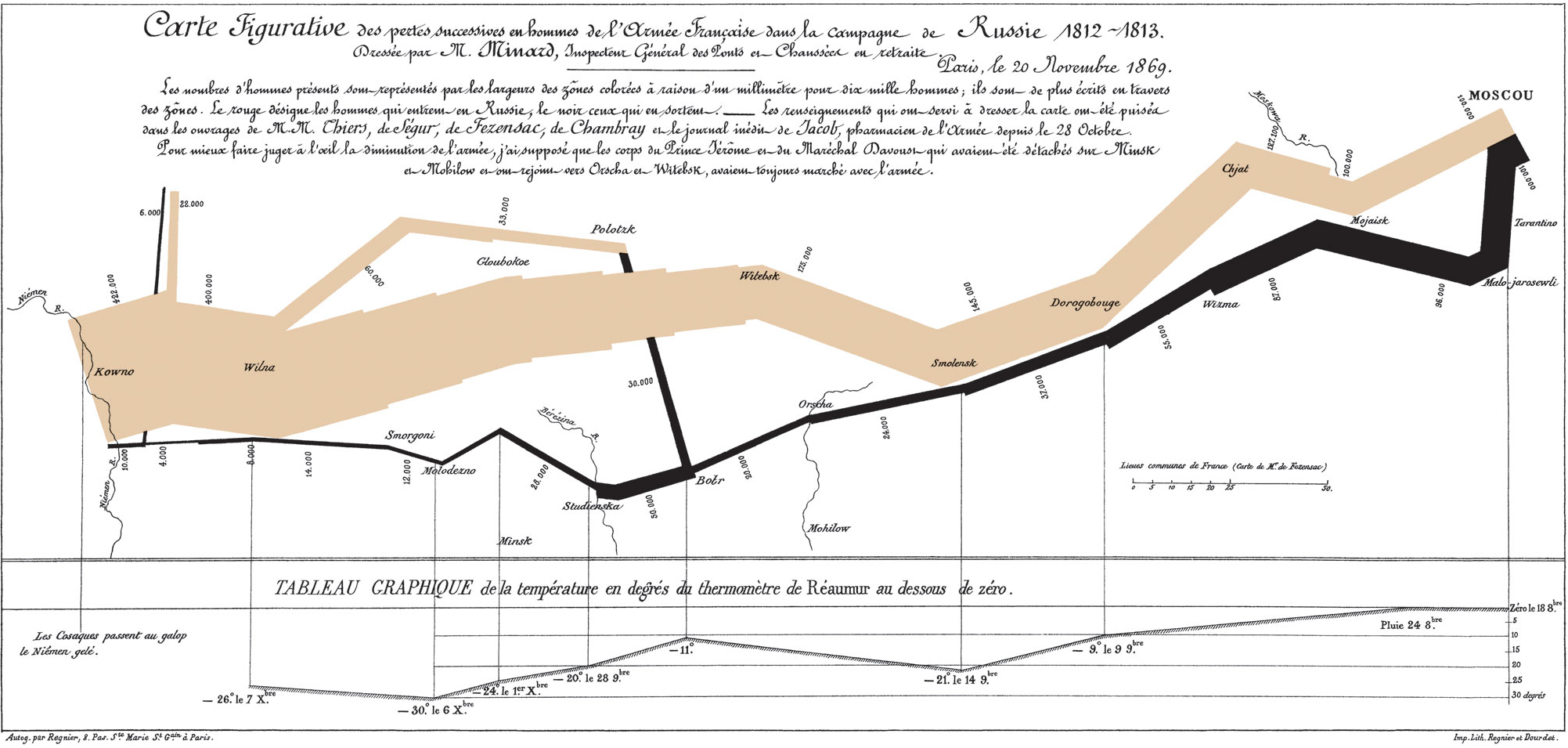
Of course, data visualizations are an important part of history as well. Historians regularly use timelines, but they also employ maps to visualize and analyze complex spatial processes, changes, and relationships, or graphs to compress and analyze broad, otherwise invisible patterns. In addition, different kinds of data visualization have played a central role in human endeavors and helped shape historical events and processes. For example, one of the world’s oldest surviving maps dates back to ancient Egypt, about 1160 BCE, and shows a route to a stone quarry likely used to help Pharaoh Ramses IV access materials for statuary. Physician John Snow’s 1854 map of the cholera outbreak in the Soho District of London, which pointed to the Broad Street water pump as the source of infection, is widely regarded as a milestone in the mapping of disease and as a turning point in our understanding of cholera—a disease that has killed millions of people throughout history. Thus, data visualizations are among the many primary sources that can and should be used to study the past. And just as students need help in understanding the difficult language in verbal primary sources, they also need support in interpreting data visualizations as visual primary sources.
Data Visualizations as Secondary Sources
The fact that data visualizations can be primary sources of information in social studies is one reason to teach them, but another reason is that they are also widely used as secondary sources of information about social studies content. To begin, consider the typical social studies textbook. Most of them are filled with data visualizations. A recent study of social studies textbooks revealed that a data visualization appears, on average, every 13.6 pages read in elementary school, every 7.2 pages in middle school, and every 4.8 pages in high school. These are not just decorative visuals. On average, 90% of data visualizations in social studies texts provide students with extensional information not found in the main body of verbal text. Therefore, failure to attend to these data visualizations may hamper students’ overall comprehension of the information provided in the text.[4]
A lack of attention to data visualizations in texts may also prevent students from acquiring disciplinary content that will serve as critical background knowledge in their later studies, including background knowledge necessary for students to understand references to people, places, events, or documents in the large portion of data visualizations that do not themselves provide background or context for the academic topics they address.[5] There is also evidence to suggest that reading data visualizations helps students better understand historical and geographic context, multiple causation, and change over time—all important concepts for them to grasp in social studies subject areas.[6] Therefore, it's not only important to pay attention to teach the data visualizations that are already included in texts, but also to use data visualizations as enhancements to social studies lessons. Luckily, there are numerous websites with datasets and data visualizations that are useful for social studies, whether for teacher-directed instruction or for student-centered research. But of course, there are good reasons to teach data literacy beyond helping students learn required content in their social studies classes. As discussed in the previous module, data literacy is really important for citizenship—it will help students make sense of all the information about politics, society, and economics that they will face as adults. The more adept students become with data visualizations, the more prepared they’ll be to deal with all the data visualizations outside of school. As the next section argues, there will be a lot of them, and they will come in a variety of forms.